Cut on a Gesture or Cut on a Look?
Cut on a gesture or cut on a look? Learn how action matches and eyeline cuts direct attention, clarify screen space, and shape a viewer’s expectations.
The common mistake with a cut on a gesture or a cut on a look is treating both as ways to make a transition feel smooth. That can blur the edit’s choice: a gesture carries movement across the cut, while a look points the audience toward something. Confuse them, and the next shot may feel busy or oddly unmotivated, even when the images match neatly.
These are different ways to direct attention. One asks, “Where did the action go?” The other asks, “What is the character seeing?” Once you can hear those questions inside an edit, you can choose a cut for its meaning, not just its polish.
A gesture carries movement across the cut
A cut on a gesture, often called a match on action, begins an action in one shot and continues it in the next. A character raises a hand in a medium shot; the edit lands on a closer shot as the hand reaches a door handle. The movement gives the viewer a small bridge between two framings.
The cut does not need to fall at the exact same point in the motion. It often works best when the first shot starts the action and the next carries its completion. The audience sees enough movement to connect the images without watching the whole gesture twice.
Action matching can preserve the feeling of continuous time while changing the view. It can bring us closer to a prop, reveal a reaction as a movement finishes, or shift from a character’s body to the object they touch. Its main subject is the action itself.
A look creates a question and points to an answer
A cut on a look, commonly called an eyeline match, links a character looking offscreen to a shot of what appears to be in that direction. The first shot gives us the glance; the next supplies its object. The edit turns a look into a brief question, then answers it with an image.
The second shot need not show the precise object the character sees. It might reveal a person entering, a light in a window, or an empty chair with emotional weight. The connection comes from the apparent direction of the gaze and the context the sequence has established. The edit links attention, not motion.
This cut also builds screen space. A face in one shot and a doorway in the next can feel like parts of one room, even when the camera positions differ. The viewer infers a relation: someone is looking from here toward there.
The cut changes what the viewer is asked to follow
Consider a simple scene. A person reaches toward a ringing phone. If the edit follows the hand as it lifts the receiver, the viewer tracks the movement and its result. If the person pauses, looks toward the phone, and the edit shows the receiver on the table, attention shifts from the person’s motion to the object they have noticed.
In the first version, the gesture carries the scene forward. In the second, the look makes the phone newly significant. The distinction can be subtle, but it shapes whether a moment feels like ongoing business or a discovery.
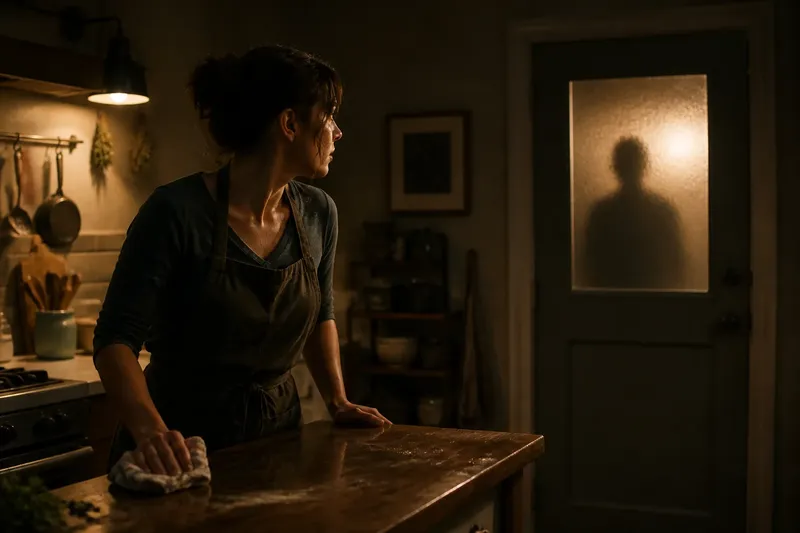
Say you are cutting an invented scene in which a cook wipes a counter, hears a tap at the kitchen door, and turns toward it. You place a medium shot of the cook beside a closer shot of the door. In one version, you cut as the cook’s shoulder starts to turn, then continue that movement in the closer view; the observable result is a flowing turn that emphasizes the cook’s action. In another version, you hold on the cook’s face until the eyes shift, then cut to the door’s frosted glass; the observable result is a glance that makes the shape beyond the glass the focus. The tradeoff is clear: the first version stresses movement, while the second gives the unseen visitor more suspense.
Match the cut to the kind of attention you want
Before choosing, ask what should lead the viewer through the transition. If the scene depends on a physical task, an action match may be clearer. If the next image matters because a character has noticed it, an eyeline cut can establish that relationship. Sometimes both cues are available, but one should do the main work.
- Check whether the action is still underway. If the movement needs to continue in the next shot, cut during it and let the second shot complete it; if the action is already resolved, hold or cut on the character’s next meaningful cue instead.
- Check whether the direction of movement matches. If the arm or body travels in a consistent screen direction, use the action match; if the direction reverses without a clear reason, adjust the cut or choose a different angle.
- Check whether the character’s gaze is clear. If the eyes settle toward a specific offscreen area, follow with a compatible view; if the glance is vague, hold on the face or establish the space first.
- Check whether the object should register as a discovery. If the audience should learn what the character sees at the same moment, show the look before the object; if viewers should recognize the object first, show it before the reaction.
- Check whether the pause carries meaning. If hesitation or completion is part of the beat, let the action finish before cutting; if the next view adds useful information, cut before the gesture resolves and complete it there.
- Check whether the audience needs time to read the face. If the expression changes the meaning of the glance, hold on the face before showing its object; if suspense depends on the unseen target, show that target promptly after the look.
These are choices, not laws. A cut can be intentionally abrupt, and a look can remain unanswered. What matters is whether the interruption or delay serves the moment instead of confusing its basic geography.
Small timing changes alter the emotional reading
In an action match, cutting earlier can lend a gesture urgency. Cutting later can make it feel deliberate, hesitant, or complete. The next shot’s scale matters too: a close view of fingers on a latch makes the action tactile, while a wider view keeps the character’s posture and surroundings in play.
With a look, the length of the glance affects how strongly the audience attends to it. A quick flick of the eyes may suggest a passing notice. A held gaze can make the unseen object feel consequential before it appears. If the editor shows the object first and the look afterward, the relation changes again: viewers may interpret the character’s expression rather than discover the object alongside them.
Neither approach has a single emotional meaning. A character looking at a doorway might be afraid, curious, or simply checking the room. The performance, shot size, surrounding images, and timing shape the reading together. The edit directs attention; it does not dictate every feeling.
Continuity depends on more than a matching movement
For an action match, compare the action’s direction and apparent speed across the cut. If an arm travels left to right in the first shot but seems to reverse in the next, the movement may feel like a jump rather than a continuation. The hand’s position, the prop’s placement, and the point where the motion resumes all contribute to the connection.
For an eyeline match, ask whether the gaze and the next image seem to occupy compatible parts of the scene. A character looking toward screen right followed by an object on screen left may suggest a different spatial arrangement unless the sequence has already established a reason. The viewer does not need a map, but does need enough orientation to understand the relation.
One everyday analogy is passing a cup across a table. If you follow the hand carrying it, you are tracking an action. If you notice someone watching the cup, you are tracking their attention. The cup is unchanged; the path of attention is not.
Which cut should you choose for this moment?
Can a cut on a gesture also be an eyeline match?
Yes. A character can turn toward a window while lifting a curtain, and the next shot can continue the hand movement while revealing what lies outside. Decide which cue should read first: the continued action or the newly revealed view.
Should the edit show the object before or after the look?
Show the look first when the audience should discover the object through the character’s attention. Show the object first when the character’s response is the important information or when the viewer already knows what is there.
Does every glance need a matching shot?
No. A glance can lead nowhere visible, or the scene can remain on the character while the unseen object stays uncertain. Add a shot of the object only if it advances the scene’s attention, space, or information.
How can I tell if the cut feels motivated?
Watch the moment without sound and note what your eye follows: the body’s movement or the character’s gaze. If the next image answers the cue you noticed, the transition is legible; if it answers a different cue, adjust the timing or shot order.
Let the transition carry one clear promise
When deciding whether to cut on a gesture or cut on a look, identify the promise the outgoing shot makes. A moving hand promises continuation; a directed glance promises a point of attention. The next image can complicate that promise, but it should do so deliberately.
In a rough edit, try the same neighboring shots with the cut placed on the movement, then with the cut placed after the eyes settle. Watch where your attention lands and what you expect to see next. That comparison can reveal whether the scene is powered by an action continuing or by a character noticing something. Keep the cut that makes the intended cue easiest to read, and revisit it if the surrounding shots later change.