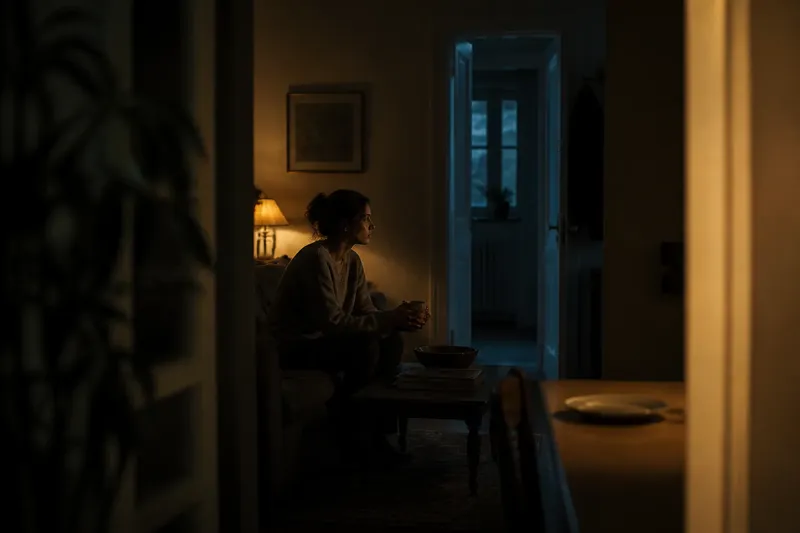
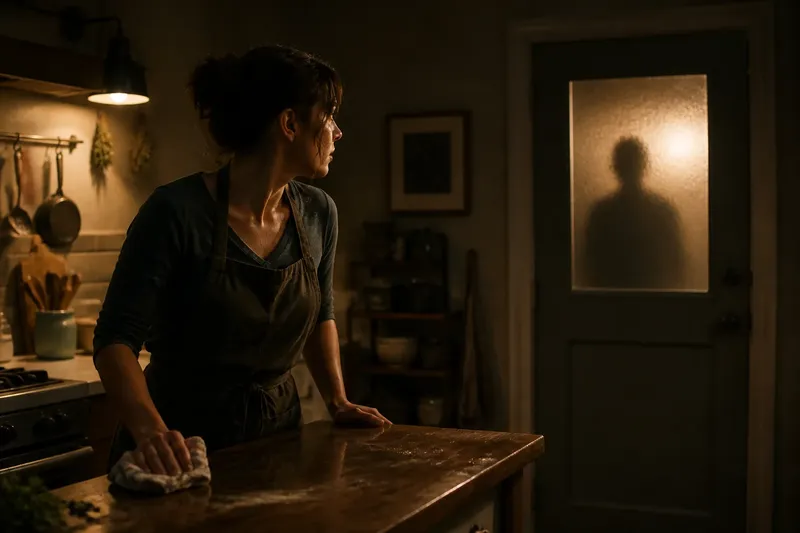
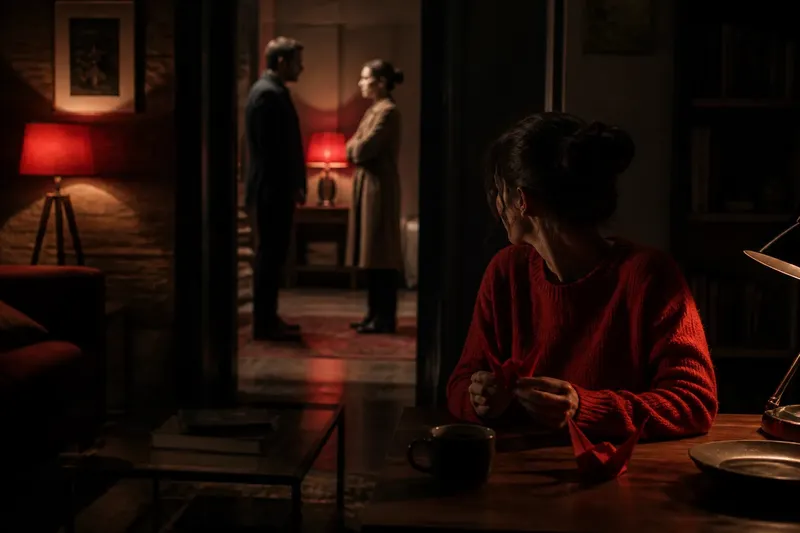
Before Dialogue Took Centre Stage
Before dialogue took centre stage, filmmakers made gesture, staging and intertitles carry the story. Learn how to read those choices on screen.
The most common mistake when watching an early silent film is to treat its intertitles as missing dialogue and its gestures as exaggerated acting. That costs the viewer the story’s original rhythm: before dialogue took centre stage, filmmakers arranged bodies, objects and written cards to make meaning visible. To read that craft, follow the scene in the order it unfolds, not as though a modern soundtrack has been removed.
Start by noticing what the film asks you to watch
Choose a short scene, preferably one with a clear exchange between characters. Watch it once without pausing. Do not try to translate every movement into a line of imaginary speech. Notice instead where your attention goes: a face, a hand, a doorway, a prop, or a written card.
Then watch again and track the screen’s arrangement. Who stands near whom? Which character is placed apart? Does someone cross the room, turn away, or remain still while others move? These choices are part of the action. A figure who steps between two people can interrupt a conflict without saying a word; a character held at the edge of a group may be visibly excluded.
Early screen storytelling drew on traditions that audiences already knew, including stage performance, pantomime and illustrated storytelling. Film added its own tools: the camera could select a gesture, preserve a pause, and show a detail that a theater audience might have missed. The result was not simply theater recorded without voices. It was a developing visual language, shaped by the screen’s ability to arrange and repeat images.
Read gesture as a change in intention
Start with the movement, then ask what changes. A hand reaching toward a letter may signal curiosity; the same hand withdrawing can turn curiosity into fear. A nod might grant permission, acknowledge a plan, or simply reassure another character. Its meaning comes from the situation and the response it receives.
Look for gestures that begin, stop, or reverse. These are often easier to read than a pose held for the camera. Notice whether another character sees the movement. If a person hides a note and then checks the room, the glance gives the action a private quality. If someone openly presents it, the scene may instead make the gesture an announcement.
Performance styles varied. Some films used broad, clearly shaped motions that could be read across a theater; others relied more on facial expression, blocking and close views. Avoid assuming that every large movement is “overacting.” Ask what information it makes legible at that point in the scene. A lifted arm may identify a refusal quickly; a subtle pause may make the refusal feel uncertain.
Follow the staging before assigning a meaning
Next, map the scene’s relationships through position and movement. A doorway can divide a private room from a public one. A table can keep two characters apart or give them a shared object to handle. A person who approaches, retreats, or changes sides alters the social picture, even if the camera stays still.
Watch for entrances and exits. An arrival may interrupt a conversation, reveal who has been waiting, or shift a character’s attention toward a new problem. An exit can be an escape, a rejection, or a practical move to get something. The scene’s other actions help distinguish these possibilities.
Props also carry information. A key, photograph, package or piece of clothing may become the object around which a scene turns. Track who owns it, who touches it, and who can see it. Like a note passed across a classroom desk, the object matters partly because of who knows it has moved. The film may make that knowledge visible through a glance, a reach, or a sudden change in posture.
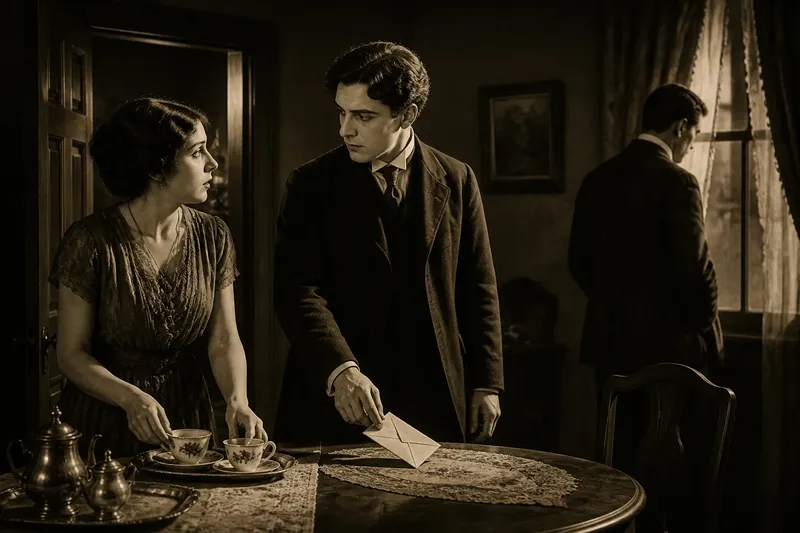
Say you are watching an invented scene in which a visitor enters carrying a folded letter. The host smiles, sees the letter, and stops arranging the cups; a third person turns toward the window. If the visitor then places the letter on the table rather than handing it over, the staging offers a readable chain: the letter changes the host’s behavior, another character avoids the exchange, and the choice of where to put it delays direct contact. That is a story conveyed through blocking and reaction, not a transcript waiting to be supplied.
Pause at each intertitle and ask what it contributes
Intertitles were inserted cards containing words, most often shown between filmed passages. Some conveyed spoken exchanges; others supplied narration, a time or place, a thought, or information the image could not easily establish. Their role shifted with the film and the scene.
When a card appears, note its function before reading it as ordinary dialogue. Does it tell you what a character says, explain a change in place, name a feeling, or move the plot forward? Then watch the image that follows. The card may direct your attention toward a face, action or object, while the actors’ responses add emotion the text does not state.
Also notice when a film leaves something unsaid. An intertitle might give only a brief exchange, letting a reaction shot carry the rest. Another scene might use several cards to make a complicated plan explicit. That balance affects pace: each card pauses the flow of moving images, but the pause can sharpen a reveal or give a performer’s reaction room to register.
Use this viewing sequence to read a silent scene
On a second or third viewing, work through the scene in order. Keep the questions specific, and write down only what the screen supports.
- Watch once without stopping. Record the broad change: who enters, what becomes a problem, or what is different by the end.
- Track the characters’ positions. Note who is together, separated, or moving between groups, and what changes when someone crosses the space.
- Follow one important object. Identify who holds, hides, offers or notices it. Ask how its movement changes the scene’s relationships.
- Choose one gesture and follow its response. Look for a visible action, the person who notices it, and the next change in behavior.
- Classify each intertitle. Mark whether it gives speech, context, thought or plot information, then compare it with the images around it.
- Rewatch the ending of the scene. Ask what has changed in the characters’ positions, knowledge or intentions. Do not add a motive that the film has not made visible.
This sequence keeps observation ahead of interpretation. If the action remains unclear, that uncertainty is useful: the film may be withholding information, or its gestures may depend on conventions unfamiliar to a present-day viewer. Either way, it is better to distinguish what you can see from what you infer.
What do silent-film gestures and titles mean?
Did silent films have no sound at all?
“Silent” describes the absence of synchronized recorded dialogue as the standard feature of the form, not necessarily an empty theater. Screenings could include live musical accompaniment or other sounds, and practices differed. For reading a scene, the central point is that its recorded image could not rely on synchronized speech to carry every exchange.
Were intertitles just written versions of dialogue?
No. Some cards represented speech, but others supplied a setting, time shift, thought or plot information. Their placement matters: a card can prepare a visual event, interrupt it for emphasis, or leave the actors’ expressions to qualify its words.
Why can silent-film acting look unusually broad?
Performers needed to make important actions readable without recorded speech, and theatrical traditions also shaped some styles. But the films are not uniform: watch how a particular gesture functions in its scene instead of treating all movement as one fixed acting style.
What changed when recorded dialogue became common?
Dialogue could carry more of the story directly, while speech, performance and sound had to be coordinated with recording and playback. The transition did not erase visual storytelling; it changed how filmmakers divided information among words, movement, staging and sound.
Listen to the image even when the characters cannot speak
A silent scene still has a rhythm. An entrance can arrive like an interruption; a held look can stretch a pause; an intertitle can make the next gesture land differently. Try watching once without added music, if the version available to you allows it, and once with its accompaniment. The images remain the same, but music may make a moment feel urgent, comic or tender. Keep those feelings distinct from what the visible action itself establishes.
Before dialogue took centre stage, screen stories asked viewers to read relationships through choices they could see: who moved, who noticed, what changed hands, and when words appeared on a card. Bring that attention to a restored silent film, a modern wordless scene, or any sequence where a character’s reaction says more than the line. The useful habit is simple: describe the visible action first, then decide what it might mean.